How to Test Towel Absorbency Before Purchase
To test towel absorbency before purchase, use the water drop method, compare GSM and pile height, and check the weave type. A practical check involves measuring time to absorb a standard volume of water and assessing dryness after a short cycle.
- Measure absorbency using a standard water volume and a timer to create a repeatable baseline.
- Check GSM and pile height, as towel weight and structure directly affect water retention and drying speed.
- Inspect the weave, since terry loop density and waffle openings change how quickly fibers take up moisture.
- Compare multiple samples from the same batch before confirming a purchase.
- Document the test conditions, such as water temperature and towel state, to ensure fair comparisons.
Why a Simple Water Test Beats a Spec Sheet
Spec sheets tell you what a supplier claims. A hands-on test tells you what the fabric does. For professional buyers evaluating bath textile inventory, towel absorbency is the single most visible performance metric. A customer who feels a towel dry slowly or holds water against the skin will return the product, regardless of the GSM printed on the label.
This guide walks through a practical, low-equipment method for checking towel absorbency in a warehouse, showroom, or sampling room. The process uses water, a timer, and a scale. It is designed for repeatable results that help you compare samples side by side and catch inconsistencies before a full production run.
What You Need Before You Start
Before handling the towels, prepare the test station. You need a flat, non-porous surface such as a stainless steel table or a plastic board. A porous tablecloth will absorb water and skew your timing.
You need a measuring tool for water. A graduated cylinder or a small beaker works well. A standard 100 milliliter volume is a good baseline. A digital scale with a resolution of 1 gram is helpful for checking weight changes. A timer, even a smartphone clock, is required.
You also need the samples themselves. Bring at least two or three towels from the same supplier. If possible, include a control towel you already trust. This gives you a reference point.
Do not use towels that have been washed with heavy fabric softeners. Softeners coat the fibers and reduce water uptake. If the towels are new and unwashed, test them as delivered. If they have been washed, test them after at least one wash cycle to see how the fabric behaves in normal use.
Step-by-Step Absorbency Test
Follow these steps for each towel. Keep the conditions the same for every sample so the results are comparable.
- Lay the towel flat. Place the sample on the non-porous surface, smoothing out wrinkles. Wrinkles create air pockets and change where the water lands. A flat surface gives a consistent contact area.
- Record the initial state. Note the date and time. If you use a scale, weigh the dry towel and record the number. This baseline helps you calculate water uptake if you want to measure grams absorbed.
- Apply the water. Pour the 100 milliliter volume slowly into the center of the towel. Pour it evenly. Do not splash. The water should land in a defined area. This prevents the water from spreading to the edges, which would slow down the absorption reading.
- Start the timer immediately. Begin the clock as the water touches the fabric. Do not wait. The first few seconds are when the surface tension breaks and the fibers begin to take up moisture.
- Watch for the dry line. Look at the wet spot. The area will shrink as the water moves into the pile. The moment the surface looks dry again, stop the timer. This is your absorbency time. A shorter time means the fibers are pulling water in faster.
- Check for bead formation. If the water sits on top of the fibers as small beads and does not sink in, the absorbency is low. This often happens when the fabric has a hydrophobic finish or when the pile is too dense and compact. Bead formation is a red flag for a bath textile that will not dry quickly.
- Flip the towel and check the back. Place the towel on the table, wet side up. Flip it over. If water has seeped through to the back, the absorbency is high but the barrier is low. For hand towels, this can be acceptable. For bath towels, you want the water to stay in the pile, not drip through.
- Repeat the test. Run the test a second time on the same towel after letting it dry completely. Some towels absorb better the first time because the fibers are dry and open. The second time may be slightly slower. Record both numbers. An average gives you a more accurate picture of performance.
- Compare to the control towel. Run the same steps on your reference towel. If the new sample takes significantly longer to dry the wet spot than your control, it is likely underperforming. If it is similar, the supplier is delivering as expected.
Common Mistakes That Ruin the Test
A test only matters if it is done correctly. These are the most frequent errors buyers make.
Using too much water. If you pour 500 milliliters, the water spreads beyond the pile and pools on the table. The test becomes a flood test, not an absorbency test. Stick to 100 milliliters.
Using a soft surface. A carpet or a fabric mat will soak up the water that runs off the towel. Your timer will stop early because the water disappears into the mat, not because the towel absorbed it. Use a hard, non-porous surface.
Ignoring the towel temperature. Cold towels absorb water differently than warm towels. If one sample is cold from storage and the other is warm from the rack, the results will vary. Let all towels rest in the room for at least an hour before testing.
Confusing absorbency with weight. A heavy towel is not always a good towel. A dense terry loop can hold a lot of water, but it also dries slowly. A lighter waffle weave may absorb quickly and dry in minutes. Always pair the water test with a weight check.
Reading the Weight and Weave
The water test tells you how fast the towel takes up water. The next step is to understand why. Two factors drive that speed: towel weight and weave structure.
Towel weight is usually measured in GSM, or grams per square meter. A higher GSM means more cotton or synthetic fibers per square inch. More fibers mean more surface area for water to land on. However, there is a limit. If the pile is too dense, water cannot reach the core of the fibers quickly. It sits on the surface and dries slowly.
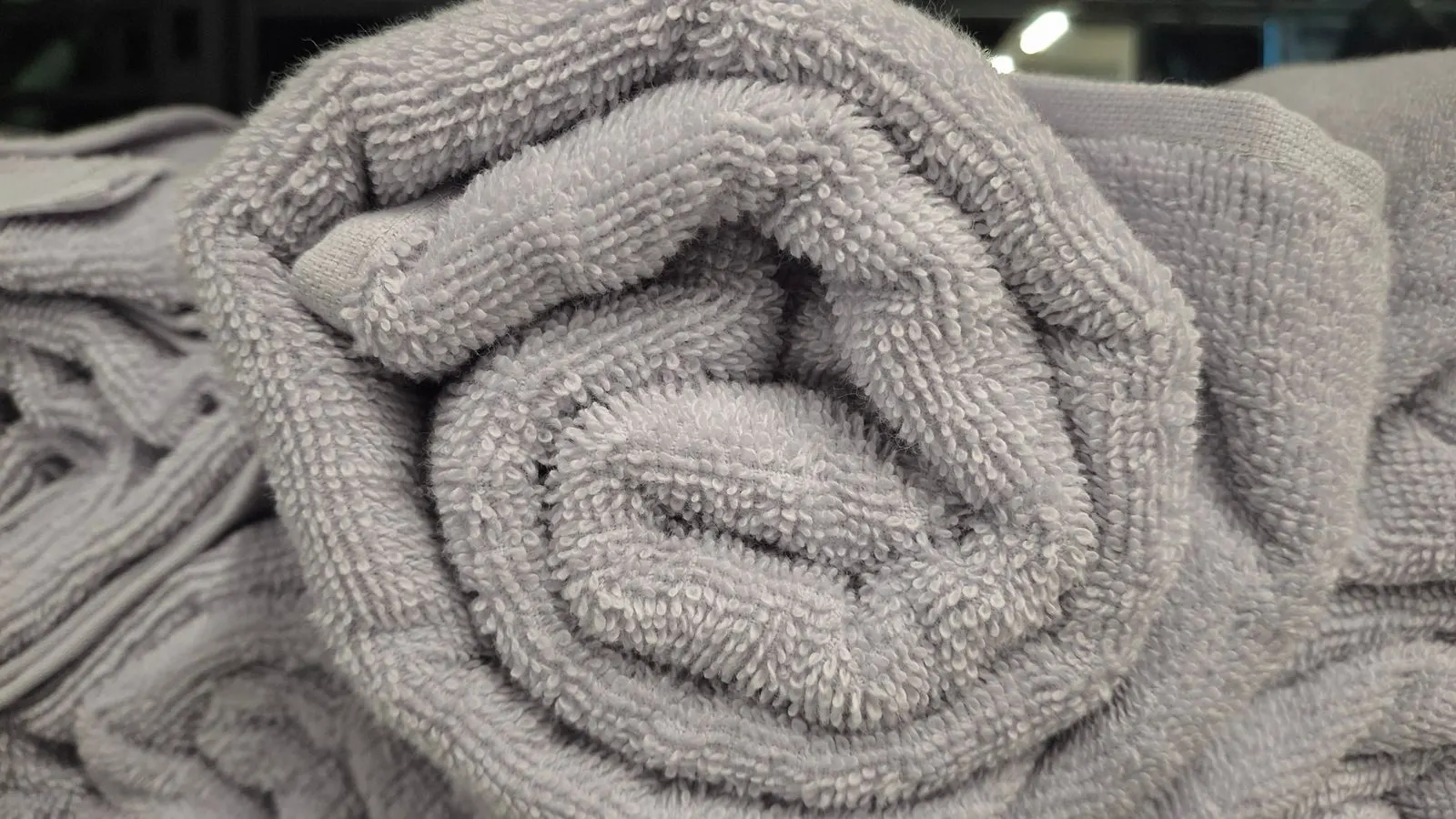
Weave structure matters just as much. Terry cloth has looped yarns. The loops create pockets that trap water. A tighter loop density increases absorbency but also increases drying time. Waffle weave has a grid of raised squares. The open structure allows air to circulate, which speeds up drying. It may absorb slightly slower than a dense terry loop, but it often wins for users because it feels dry faster.
When you look at a spec sheet, do not just look at the GSM. Look at the pile height. Pile height is the length of the loops or the depth of the waffle squares. A longer pile holds more water but also takes longer to release it. A shorter pile is more compact and dries faster. For bath textiles, you want a balance. You want enough pile to catch water, but not so much that the towel stays wet for an hour.
How to Compare Samples Side by Side
If you are choosing between two or more suppliers, run the water test on all of them at the same time. Lay them out on the table. Pour the water. Start the timer.
A simple way to track the results is to use a sheet of paper or a digital spreadsheet. Write down the sample name, the GSM, the weave type, the first dry time, and the second dry time.
| Sample | GSM | Weave | First Dry Time | Second Dry Time | Notes |
|---|---|---|---|---|---|
| Sample A | 500 | Terry Loop | 12 seconds | 15 seconds | Good surface dry, slight back bleed |
| Sample B | 700 | Terry Loop | 25 seconds | 28 seconds | High weight, slow dry, no back bleed |
| Sample C | 450 | Waffle | 8 seconds | 10 seconds | Fast dry, low back bleed, lighter feel |
| Control | 500 | Terry Loop | 14 seconds | 16 seconds | Baseline reference |
In this table, Sample A and Sample C both show fast surface drying. Sample B is heavy, but the water takes longer to penetrate the dense pile. Sample C is lighter, but the waffle structure allows air movement, which helps the water move through the fibers.
Look at the back bleed column. If Sample A has back bleed, the water is moving through the pile quickly. This can be a good thing if you want a towel that does not drip heavily, but it can be a bad thing if you want a towel that holds water on the skin. Your choice depends on the end use. For a bath towel, you generally want the water to stay in the pile so it does not drip on the floor. For a hand towel, back bleed is often acceptable.
Final Verification Step
After you have run the test on all samples, do not rush to a decision. Perform a final verification step.
Take the winning sample. Wash it in a standard cycle with mild detergent. Do not use fabric softener. Dry it in a standard dryer or air dry it completely. Once it is dry, run the water test again.
This second test tells you how the fabric behaves after washing. Some towels shrink after the first wash. The loops can tighten, which reduces the space between the fibers. This can lower absorbency. If the second test shows a significant drop in performance, the fabric may not be well finished.
If the performance holds, you can move forward. If it drops, ask the supplier for a pre-shrunk sample or a sample that has been washed three times. You want to know what the towel will feel like when it reaches the customer, not just what it feels like off the truck.
Frequently asked questions
How much water should I use for the absorbency test?
Use a standard 100 milliliter volume. This amount is large enough to create a visible wet spot but small enough to stay within the pile.
Does a heavier towel always absorb more water?
No. A heavier towel has more fiber, but if the pile is too dense, water may sit on the surface and dry slowly. Weight is just one factor.
What if the water beads on the towel?
Bead formation indicates low absorbency. This can happen if the fabric has a water-repellent finish or if the pile is too compact. It is a red flag for bath textiles.
Should I test the towel before or after washing?
Test both. Test the towel as delivered to see its initial performance. Then wash and dry it, and test it again to see how the fabric holds up after normal use.
How do I compare terry and waffle towels?
Run the same water test on both. Terry towels often have higher weight and slower drying. Waffle towels usually dry faster due to air circulation. Choose based on whether you prioritize water retention or quick dryness.